
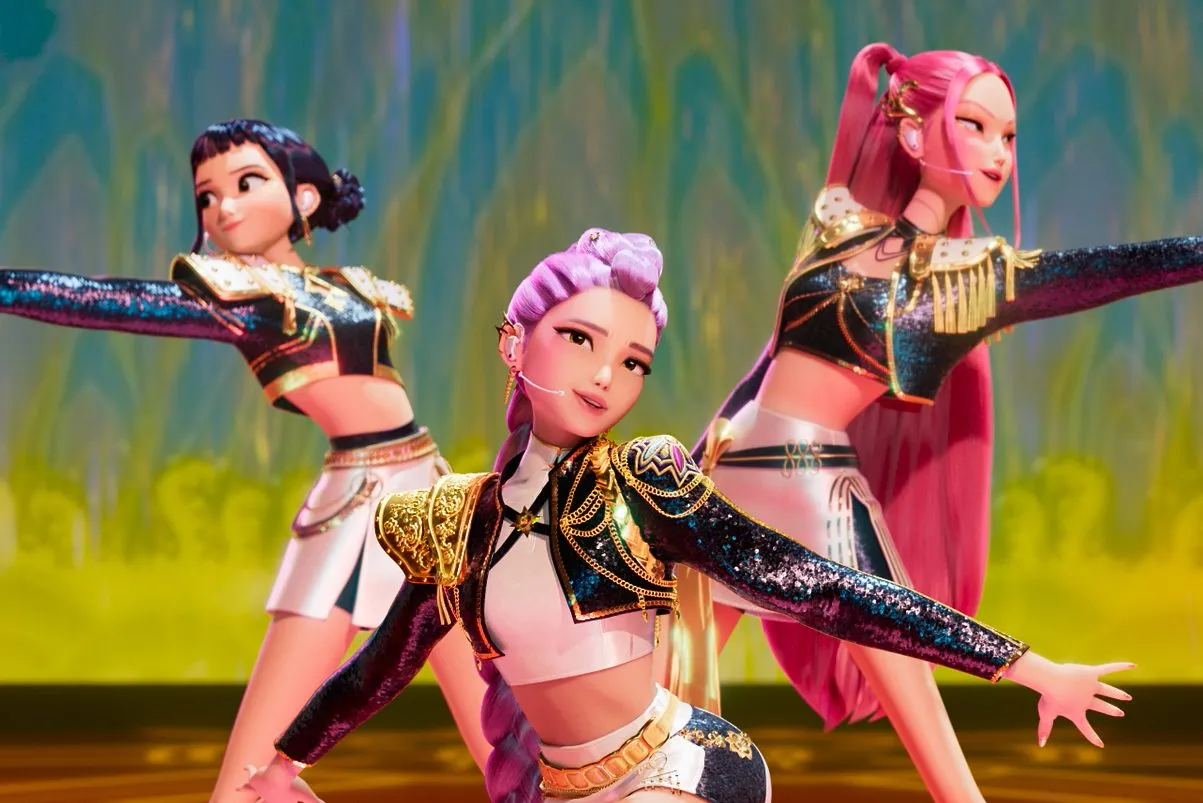
The animated phenomenon KPop Demon Hunters has already rewritten the rules of pop culture over the past year. Now it has secured its place in film history as well, becoming the first Korean animated film ever to win Best Animated Feature at the Academy Awards.
The victory caps an extraordinary run for the Netflix and Sony Pictures Animation production, which since its debut in June 2025 has evolved from an ambitious genre mash-up into one of the most globally dominant animated films of the decade.
A Genre-Bending Hit That Became a Global Phenomenon
Directed by Maggie Kang and Chris Appelhans, the film follows fictional K-pop girl group HUNTR/X, whose members Rumi, Mira and Zoey secretly protect the world from supernatural threats. Their weapons are not just martial skill but music itself—channeling song and performance to defeat demons threatening humanity.
What might have sounded like a wild concept on paper turned into a cultural juggernaut. Within two months of its release, KPop Demon Hunters became Netflix’s most-watched film ever, eventually surpassing 325 million views worldwide.
But its reach extended far beyond streaming numbers. The film’s soundtrack—led by the anthem Golden—became an unlikely chart powerhouse. Performed by HUNTR/X and sung by songwriter EJAE, the track spent eight weeks at No. 1 on the Billboard Hot 100, marking the first time a K-pop girl group, fictional or otherwise, had topped the chart.
At the same time, the film’s soundtrack made history by placing four songs simultaneously in the Hot 100’s top 10, an almost unheard-of achievement for an animated film.
The road to the Oscars was nearly a decade in the making. The character of Rumi, the purple-braided leader of HUNTR/X, began life as a design sketch on a skateboard created by Kang and her husband, storyboard artist Radford Sechrist. Kang later built an entire film concept around the character.
The idea crystallized when Kang combined her lifelong love of K-pop with Korean folklore.
“I wanted to do something with demons,” Kang has explained. Inspired by the visual imagery of Korea’s grim reapers and shamanistic traditions, she began imagining pop stars who used music as a weapon against supernatural forces.
That connection proved key. In Korean mudang traditions, forms of shamanism, music, chanting and dance are used to ward off spirits. Translating that ritual into a pop spectacle allowed the film to merge mythology with the hyper-stylized world of modern K-pop.
It also gave the filmmakers a broader cultural mission: to create what Kang described as “the most Korean movie” she could.
Korean Culture at the Center
Part of the film’s appeal lies in how deeply it draws from Korean culture while presenting it in a global pop format. The visual design blends traditional Korean aesthetics with haute couture influences from fashion houses such as Givenchy and Alexander McQueen. Even small details, from hairstyles to nail art, were carefully designed to reflect contemporary Korean style.
Music was just as essential. The filmmakers spent years refining the soundtrack, reportedly going through eight different versions of “Golden” before settling on the final track.
The result was a musical approach that fused K-pop production with elements of traditional Korean performance styles such as pansori, giving the film a sonic identity distinct from Western animated musicals.
A Cultural Impact Beyond Animation
The film’s popularity quickly moved beyond the screen.
Children around the world began dressing as the characters for Halloween, often wearing Rumi’s now-iconic Korean-inspired braid. Social media filled with sing-along screenings and fan videos, while audiences of all backgrounds embraced Korean lyrics from the soundtrack.
The cultural ripple effect even reached institutions in South Korea. According to reports from the film’s creative team, visitor numbers at Seoul’s National Museum rose significantly after the film’s release, as audiences became more curious about the traditions and history referenced in the story.
For many involved in the production, that broader cultural exchange remains one of the film’s most meaningful achievements.
Awards Momentum Leading to the Oscars
By the time awards season arrived, KPop Demon Hunters had already built formidable momentum.
“Golden” became the first K-pop song ever to win a Grammy Award for Best Song Written for Visual Media, while the soundtrack broke streaming and chart records worldwide. The singers behind HUNTR/X—EJAE, AUDREY NUNA, and REI AMI—were later honored collectively as Women of the Year at Billboard’s Women in Music ceremony, another historic first for a group.
The Oscar win for Best Animated Feature therefore felt less like a surprise and more like the culmination of an extraordinary year.