
The cast and crew list for HBO’s Harry Potter reboot keeps growing, and so, increasingly, does the list of people attached to it who want the record to show they don’t agree with the woman still cashing the biggest checks off it.
This week, two directors said publicly what a growing number of the show’s own actors have already been saying for months: they want no part of working alongside J.K. Rowling, specifically over her anti-trans activism.
Writer-director Ally Pankiw (Schitt’s Creek, Black Mirror) posted a screenshot to Instagram of a text exchange with her agent, who’d asked, almost apologetically, whether she’d be interested in directing an episode. “Harry Potter? Hard no?” the agent wrote. “Absolutely f**king not! lol,” Pankiw replied, adding in a follow-up post, “It simply is this easy to say ‘no’ to funding transphobia.” Director Kate Herron, known for Loki, also responded in the comments, saying that she’d been approached twice and had to explain both times that her answer wasn’t going to change. Pankiw thanked her publicly for saying no twice, calling it “actually hard.”
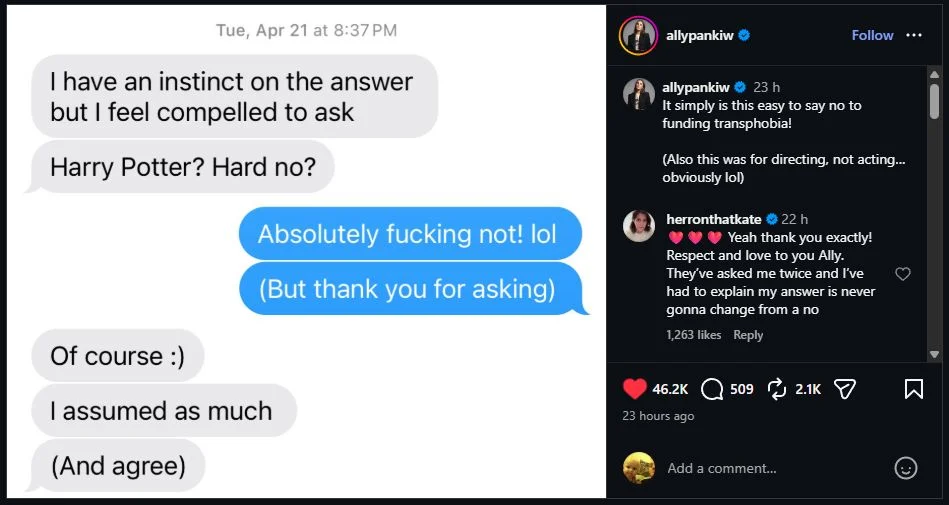
It’s a rare thing, a working director turning down a major studio job specifically to protest one of the people profiting from it, and some of the show’s own cast have voiced similar sentiments.
Bel Powley, who plays Petunia Dursley, and Paapa Essiedu, who plays Severus Snape, have both spoken publicly in support of trans rights. Powley told The Telegraph she “strongly disagree[s] with J.K. Rowling’s views on gender,” while also being clear that her love for the books, and for the franchise she grew up on, remains genuine and separate from that disagreement.
Essiedu went further last year, signing an open letter in support of trans rights in the UK, which prompted online speculation that Rowling might push to have him removed from the series. Rowling responded to that speculation directly, stating she doesn’t have the power to fire an actor from the show and wouldn’t use it if she did, adding that she doesn’t believe in taking away people’s jobs over legally protected beliefs that differ from her own.
John Lithgow, who will play Dumbledore in the series, has been the least consistent voice among the cast, at one point asking “why is this a factor at all,” later calling Rowling’s stance “ironic and inexplicable,” and more recently describing her views as having been “twisted and misrepresented,” a shifting position full of hypocrisy that hasn’t gone unnoticed.
Whatever any of them individually feel, the series is still set to generate significant money for Rowling, who serves as an executive producer, and that money isn’t going to places that want to do any good for this world.
Rowling has spent years directing large portions of her fortune, built almost entirely on the Harry Potter franchise and its spinoffs, into funding legal efforts aimed specifically at rolling back rights for transgender women in the UK and Ireland. A spokesperson has confirmed that her JK Rowling Women’s Fund has been operating quietly since late 2024, supporting what the fund describes as legal cases involving “women’s and girls’ sex-based rights.”
Before that fund existed, she’d already pledged roughly £70,000 to For Women Scotland, the group behind the legal challenge that led to the UK Supreme Court ruling excluding trans women from the country’s sex-based discrimination protections. Since late 2024, the fund has also offered financial and legal backing to cisgender women who say they’ve lost work or face tribunals over anti-trans beliefs, and to individuals or organizations opposing single-sex space inclusion policies.
HBO, for its part, hasn’t shown much appetite for engaging with any of this directly. Casey Bloys, the network’s chief executive, has repeatedly waved off questions about Rowling’s politics, telling The Town podcast that being in business with her isn’t new, that Warner Bros. has worked with her for 25 years, and that her views are simply “her personal, political views” she’s entitled to hold. They have even doubled down on their partnership with Rowling, calling her “very, very involved” as the executive producer of the upcoming series.
Ever since I was a kid, I was told that Harry Potter is a story about love and acceptance, and certainly, that was what I thought as well when I first watched the movies, that it was indeed a story about misfits finding their place in the society, and even today I feel that way when I watch the original movies as I watch this found family navigate so much loss and see them hold on to a glimmer of hope in the bleakest of times, there’s so much tenderness with the way the cast and crew have brought those story to life and it fills me with joy to see the wonderful and compassionate human beings the cast have grown into as they continue to champion human rights, a message of compassion that seems to have escaped not only the series’ author but also the people involved in the upcoming Harry Potter series.
It’s 2026, and somehow, we are still here; the fight for equality and inclusion feels more urgent than ever. And amidst all of that, HBO’s unwavering support of J.K. Rowling, despite her documented history of anti-trans rhetoric, feels not just tone-deaf but fundamentally harmful. You just can’t preach about how Harry Potter is about love and acceptance and then say Rowling’s involvement is going to benefit the project when she spends most of her time being hateful towards the trans community and denying their rights as well as their existence as a whole.
Rowling’s anti-trans activism has been the dominant theme of her public discourse for years now. She has been denounced by LGBTQ+ advocates, prominent actors from the original franchise, and even longtime fan communities like MuggleNet and The Leaky Cauldron, who severed ties with Rowling years ago.
Melissa Anelli, author of Harry, a History, has previously highlighted how “every conversation about Harry Potter turns angry and depressing,” she says. “The person at the center of it believes a certain faction of the population isn’t real.”
By giving Rowling a platform and a prominent creative role in the new series, HBO is not just endorsing her as a storyteller but also legitimizing her harmful views under the guise of creative freedom. Fans have rightfully argued that this is not just a matter of respecting “personal beliefs” but a failure to stand against hate and uphold basic human rights.
Rowling’s influence amplifies a broader cultural war against transgender rights, which are under attack globally. From legislation targeting trans youth in the U.S. to debates over gender-affirming care, the harm of anti-trans rhetoric is tangible and immediate.
Are the rights and dignity of trans people really this easily negotiable? HBO certainly makes a case for that.
PLEASE CONSIDER DONATING!
If you’ve found value in our writing and want to support it, we are accepting donations starting at just $1. Unfortunately, display ads generate very little revenue, and we are unable to monetize our work in any meaningful way. At the moment, reader support is the only way this work can be financially sustained. Even a dollar helps keep this sustainable and allows us to do something about it.
DONATE HERE!
Trans rights are human rights, and anybody who is an ally does not owe any empathy towards a bigot like Rowling. If there were this much hard evidence of her remarks being racist or anti-Semitic, she would probably not have even been considered for this role, but I suppose transphobia is probably not the kind of bigotry that is on HBO’s list of priorities. After all, why should anyone care about minorities and the rights of those less privileged than them?